By Naomi Klein, 27 November 2026
Last Saturday in Paris, I was in a theatre packed with hundreds of people who came together to reject the idea that rule by billionaires is a law of nature. The gathering was called the First Paris Summit Against International Oligarchy. It felt significant that it wasn’t hiding behind lukewarm words like “inequality” or “affordability.” It named the oligarchy, i.e., governance by a corporate elite, in their narrow interests. As climate talks break down during the warmest year on record, and the U.S. President intervenes again and again to keep the AI casino going, that is the system under which we are living.
Gabriel Zucman and the International Tax Observatory convened the summit, together with the Independent Commission for the Reform of International Capital Taxation (ICRICT), the Stone Centre on Wealth Dynamics, the Théâtre de la Concorde, and the City of Paris. Zucman has been instrumental in challenging the myth that nothing can be done about extreme wealth. Astra and I cite him in the concluding chapter of End Times Fascism (the part about abolishing billionaires).
Joseph Stiglitz, Esther Duflo, Thomas Piketty, Jayati Ghosh, Lea Ypi and Isabella Weber were among those sharing ideas about practical steps we can take to begin dismantling this untenable economic model. Several elected politicians and party leaders were also on stage, pledging to put these ideas into practice. On the streets outside, Parisians continued their months-long revolt against austerity, kicked off by working-class high school students, demanding the right to learn in classrooms that aren’t falling apart. It felt like a moment.
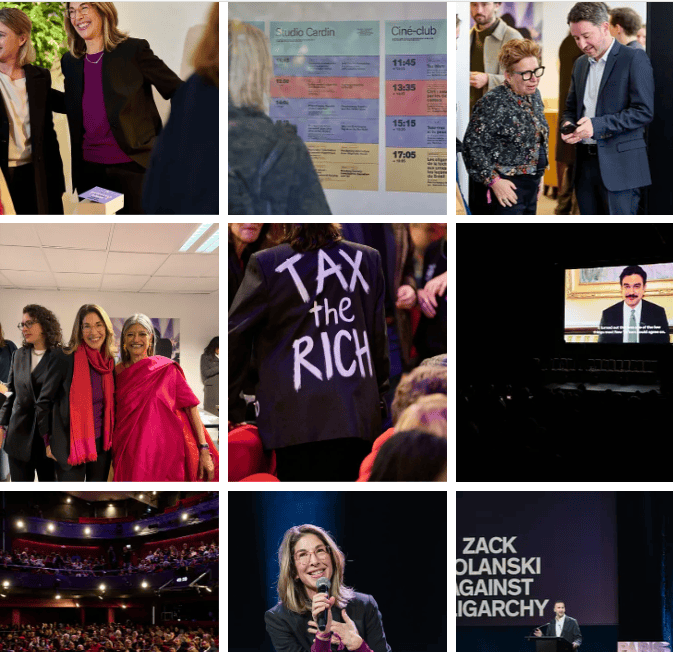
It was my privilege to be included among these economists, philosophers, journalists, and trade unionists who were organizing around three fights:
- Tax: stopping the secession of the ultra-rich from the societies that made them rich
- Media: freeing public debate from billionaire owners
- AI: deciding who owns the knowledge that humanity created together over centuries
It’s easier to look at these three strands as part of a single weave. The same handful of men who own our platforms are buying up our media and racing to turn collective human creativity and knowledge into private property. Too often, as Zucman points out in his work, they also pay lower tax rates than the workers who clean their offices.
That is why I signed the Paris Manifesto, along with more than a hundred economists, philosophers, historians, and organizers. None of this is pie in the sky. It asks for a 2% minimum tax on fortunes above $100 million, real legal protection for newsrooms against the owners who would censor them, and a non-profit, democratically governed model for AI. Its core argument is one I have talked about a lot before: oligarchy has connected its various threads to become a global network, so our resistance has to be too.
I’m reprinting the opening of the manifesto in English below, with permission. I encourage everyone to read it, share it, debate it at the dinner table, and bring it to the people in your life who think things are the way they are and there’s nothing we can do about it.
The explosion of extreme wealth is the major social fact of our time.
Together with more than 100 researchers from around the world (economists, political scientists, legal scholars, sociologists, philosophers, historians and others), we are sounding the alarm: billionaires are a threat to our democracies.
When Forbes magazine began ranking the world’s largest fortunes in 1987, the wealth of the richest 0.0001%, about 1,500 households at the time, amounted to the equivalent of 3% of global gross domestic product.
In 2026, that same tiny fraction of the population, which now comprises nearly 3,000 households as a result of global population growth, holds wealth equal to 17% of global GDP.
This shift has upended the balance of power: the power to steer multinational corporations whose choices, such as the decision to develop artificial intelligence, affect all of humanity; the power to shape the dominant ideology by buying up newspapers, radio stations, television channels and social networks; and the power to sway public policy by funding election campaigns and candidates.
This power is self-reinforcing, in a dynamic that corrupts contemporary democracies. As their economic might has grown, the oligarchs have spent ever more to defend their interests. The economic power of the wealthiest is thus used to strengthen their political power, and vice versa.
Lost from view in the decades after the Second World War, when inequality had fallen to a historic low, the tension between democracy and oligarchy has now fully returned, and is once again asserting itself as the defining issue of our time.
But we cannot understand the terms of this struggle today, nor think through the conditions for a victory of democratic forces, without acknowledging something fundamentally new. For the first time in history, extreme wealth and the power it confers are asserting themselves on a truly planetary scale.
When Elon Musk buys the social network Twitter and puts it at the service of his favored ideological causes, it is not only the American republic that falters; the very terms of public debate, the heart of the democratic life of nations, are transformed in many countries.
When Donald Trump cuts the corporate tax in the United States and dismantles financial transparency rules, it is not only the wealthiest Americans who benefit, but oligarchs the world over, who can make their business in the United States more profitable still.
When a handful of tech barons decide to cover the Earth with data centers that devour energy and water, it is not only the resources of Tennessee or Inner Mongolia that are being seized; it is the planet as a whole that is hurtling toward the abyss.
Extreme wealth always means extreme power, and billionaires are right to point out that their fortunes do not consist mainly of gold bars or cash. They consist of far more than that: above all, control over the course of the world’s major corporations, through the share portfolios they hold, which make up the bulk of their wealth.
Against the international oligarchy, we must now build a democratic International.
With a minimum tax on the ultra-rich combined with the recovery of past unpaid taxes, stronger media independence and better protection of journalists against interference and censorship, and a new model of ownership, international and deprivatized, for artificial intelligence companies, the world’s democratic forces can regain the upper hand.
The survival of democracies and the habitability of the planet are at stake. Join us!

